David McGregor
This project is part of an ongoing series of work I have been developing where I consider wildfire perimeters as a type of drawing. The perimeters are created by GPS equipped helicopters flying the perimeter of a fire. In this way, the shapes that are created to show the extent of a fire become a kind of drawing, interpreted by a pilot and a machine. This interested me as a metaphor for how we are collectively struggling to understand the impact and extent of wildfire as a force, we can only know an interpretation of it’s outer boundary. At the same time, the lines of the fire perimeter are varied, some are shaped by fire suppression efforts, some by lakes or roads, and other areas are at the mercy of the weather and what forms of fuel are available to the fire. This project is a way to consider different dialects of mark-making in relation to fire as well as how these elements interact with a specific place.
Greg Deagle
Greg Deagle’s art is balanced on a delicate threshold between realism and abstraction resulting in pieces that are both formally vigorous and eternally evocative. The authenticity of his mountain landscapes from his intimate familiarity with the Jasper area where his family has lived for generations.
Verdure Abstraction – Parts I, II and III is an art project shaped by the raw, searing legacy of the 2024 Jasper Wildfire Complex, a wildfire that devastated one third of our community leaving a trail of human displacement, separation from friends and neighbours and damaged lives in its wake. Creating these was both cathartic and complicated, stirring not just memories but also deep questions about how we, collectively and individually, carry the imprint of such a traumatic event.
Layering scorched landscapes and fragile regrowth in charcoal, ink, gouache and actual flame (sfumato), I found myself grappling with a persistent question: At what point does remembrance become a barrier to healing, and when does letting go risk forgetting the lessons etched in smoke, flame and recovery?
My community holds different perspectives. Some feel that immortalizing the wildfire through art and creative expression reopens wounds hindering the natural process of moving forward and acting as a trigger rather than a salve. Others believe that keeping the memory alive through art is vital—not to anchor ourselves in sorrow, but to honour the experience, to learn, and acknowledge how profoundly the event has shaped us.
Art, I realize, occupies a unique space in this tension. It doesn’t dictate how to feel or prescribe a timeline for healing. Instead, it reflects, questions, and sometimes challenges. Verdure Abstraction isn’t just about depicting the wildfire’s devastation; it is about exploring resilience, the fragile beauty of regrowth, and the complex intertwining of loss and hope.
In sharing this series, I hope to invite dialogue—not just about the wildfire itself, but about our varied paths to healing and remembrance. Maybe it’s not about finding the right time to let go, but respecting the diverse ways we each navigate the embers of memory.
Katie Potter
Katie Potter is a Jasper based artist who’s work has always been deeply rooted to the beautiful mountain landscape of her hometown. Working without formal artistic training, her practice has always been guided by a deep love and attentiveness to the land.
Following the 2024 Jasper wildfire, which changed the landscape of not only the town she spent her life in, but her life also as she knew it as well. Her apartment was lost in the fire, and she had no choice to relocate to Edmonton for a year.
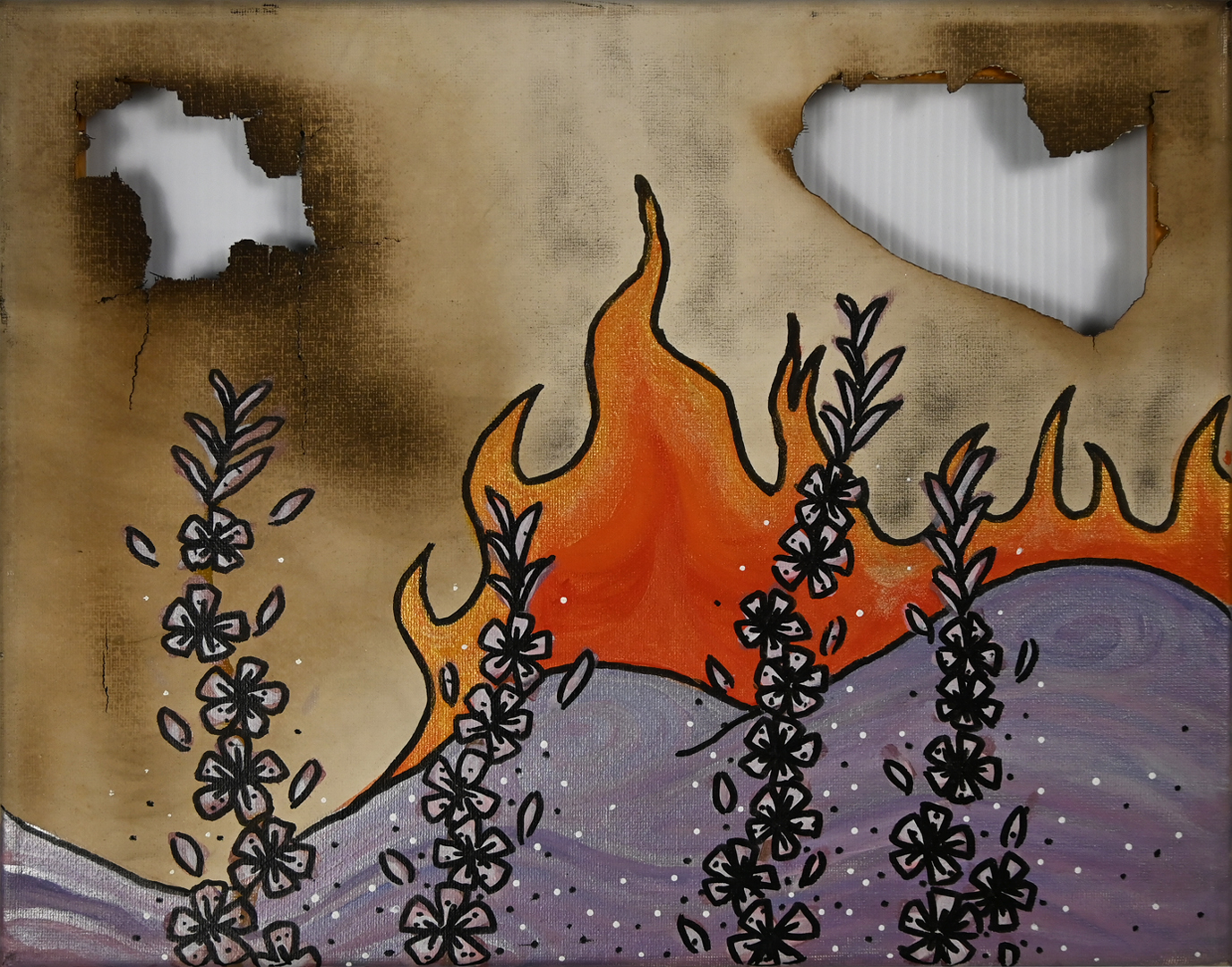
Upon visiting Jasper the day the evacuation order was lifted, she was inspired by the unpredictable nature of the fire. Behind full bloom thriving flowers sat complete devastation. Katie started to utilize the power of fire, throwing canvasses directly in a live fire and letting the flame leave its mark before retrieving them. On these canvasses she painted a landscape in renewal, signifying that even though the canvas had been scorched, it can be brought back to life and be beautiful again.
Katie has since returned to Jasper and continues to be inspired by the ever changing landscape.
I burn my canvasses in a live fire before I paint them. I let the unpredictable nature of fire take over, letting it crack the surface, stain it with smoke and leave scars.
On the burnt canvasses I paint signs of renewal, but leave the charred areas visible. They hold onto what had been lost, around them I add the quiet signs that life is returning, mainly fireweed, one of the first plants to emerge after such devastation that serves as a symbol of resilience and renewal on a scorched land.
The 2024 Jasper wildfire changed the landscape in ways that felt both intimate and violent. Charred ground, burnt trees, and new growth existing all at once. Fire is not just destruction, it’s a new beginning.
These pieces are a reminder that destruction brings survival, regrowth, fresh starts and a canvas that even though charred, will always be beautiful.
Megan Green
Megan Green is a visual artist from Newfoundland who was part of a worker migration to the oilsands in the 1990’s; she completed an MFA at the University of Waterloo in 2014. Megan participated in the Banff Centre’s 2016 BRiC On Energy residency. Work from this residency was presented at the Petrocultures 2016 conference at Memorial University of Newfoundland, at the University of Edinburgh’s Postcards from the Anthropocene exhibition and published in Energy Cultures from West Virginia University Press. Her work was also included in the 2017 Alberta Biennial of Contemporary Art. Megan was an artist residence at the Klondike Institute for Arts and Culture in 2018 and in 2019 she presented at Animal Remains at The University of Sheffield. She has been the recipient of production grants from the Ontario Arts Council in 2017 and 2021, and of the Canada Council for the Arts 2021 Explore and Create program. Recent publications include an essay in Popular Inquiry: The Journal of the Aesthetics of Kitsch, Camp and Mass Culture, in the International Journal of Cultural Studies. In 2022 Megan Green had a solo exhibition at the Tina Dolter Gallery in Corner Brook, Newfoundland.
Robert Guest
Robert Guest was a noted landscape painter. His drawings and paintings were inspired by the summers he worked on fire lookout towers in Alberta, including a decade at Willmore Wilderness Park north of Jasper. He translated his memories of forest fires, moonlit nights, and the changing seasons into a living visual record of Alberta’s Peace Country.
Guest’s landscapes display all the moods, textures, colours and sublime effects of nature. His work distilled the essence of place, and revealed the mystery found in nature, and his nocturnes were widely recognized for their ability to capture the light, the colour, and all the nuance of darkness.
In 1995, Robert Guest worked tirelessly with Lone Pine Publishing to release Trail North: A Journey in Words and Pictures – a book combining Guest’s paintings and drawings, as well as his collection of stories and anecdotes, of the historic Hinton Trail. Guest hiked more than 340 kilometers of the trail over a period of seven years, and mapped, sketched, then painted the historic and scenic trail in a series of seventy-two works. Guest cited the Hinton Trail book project as one of the highlights of his career, and spoke of how around “every bend of the river, there is a painting.”
Guest’s art career spanned four decades and he contributed greatly to the strengthening and growth of Alberta’s artistic community. He was instrumental in the formation of the Peace Watercolour Society and the Prairie Gallery Society (now the Art Gallery of Grande Prairie), and was one of the first visual art instructors at Grande Prairie Regional College. He moved to Grande Cache in the nineties, and there he founded the Grande Cache Watercolour Society and continued to teach and volunteer widely. His deep commitment to his art and his community was unwavering.
Sandra Coombe
“After dancing around the edges of this calling for much of my adult life, a series of traumatic events have created the opportunity to heed the call to the canvas.
I experiment with a variety of media to translate my imaginings of colour, light and texture into compelling visual narratives, often accompanied by poetry and prose. This process enables me to advocate for the power of art to heal the collective consciousness, fostering an exchange between the viewer and the work.
My work/play draws from the immediate social and emotional landscape, the play of the landscape on the senses, creating a rich dialogue with artistic tradition.”
ABOUT THE ARTIST
Sandra’s home studio is located in Jasper, Alberta. She is influenced by a deep spiritual connection with the landscape and the many souls that she shares it with. Her creative fire is fuelled by careers in Hospitality, Performing Arts Management and Wholistic Healing. An avid gardener, horsewoman, interior designer and chef; she is never far from the creative process. Sandra is essentially self taught and explores different media and techniques through seminars, workshops and independent play.
Sandra is a fierce advocate of the Arts as a vehicle for building community resilience and connection. She is a member of the Jasper Cohort of the Resilience Project and has pieces in the Resilience Institute Collection, private Canadian and International collections.