
Carrie Allison
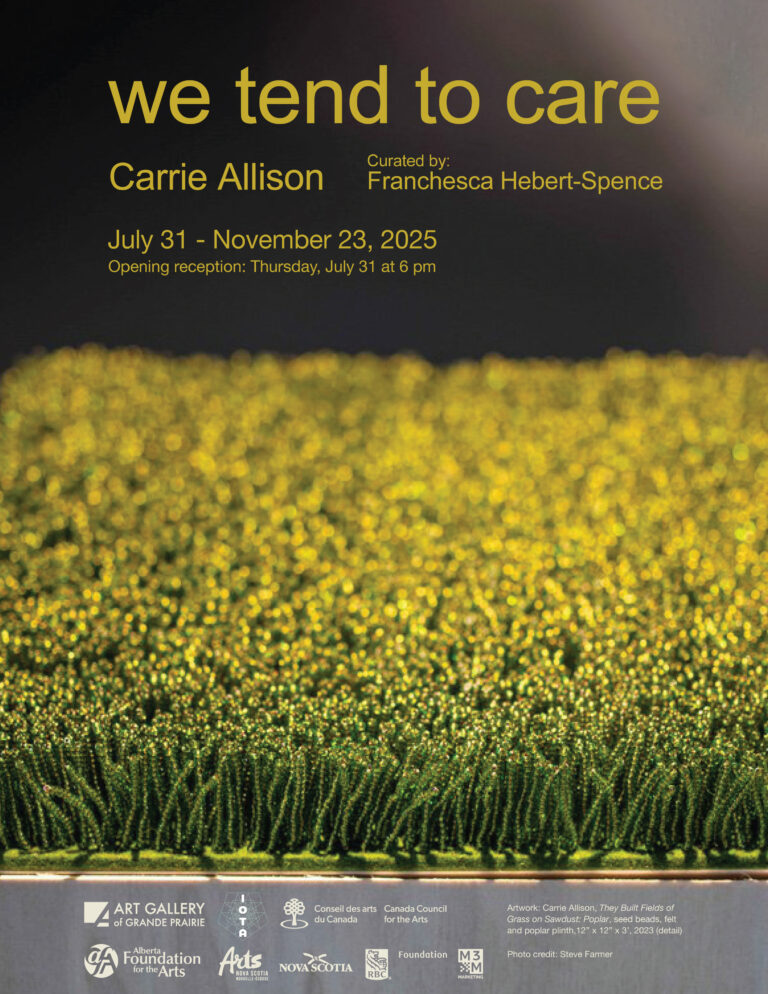
we tend to care
Carrie Allison
July 31, 2025 - November 23, 2025
Curated by Franchesca Hebert-Spence
What values, ideologies, and structures do we uphold when we mow the grass, pull up weeds, or romanticize a lush field of canola? we tend to care complicates and challenges the moral authority that green spaces hold in the public consciousness. For a decade, Carrie Allison has made art that investigates and critiques colonial subjugation strategies that are woven into the maintenance of urban green spaces and agricultural spheres. Based in a multimedia time-intensive approach, this body of work ranges from sensitive responses to Allison’s family and territory, to nihilistic predictions of future strategies that highlight the absurdity of the social transactions reinforced through lawns. This is directly related to abolition movements, Indigenous LANDBACK conversations, anti-colonial struggles, and global liberation with the dream for new futures and possibilities of liberated lawns by critiquing the spaces around us.
This is the first tour date for we tend to care , which premieres at Art Gallery of Grande Prairie (July 31st – November 23rd 2025), before travelling to Urban Shaman & Winnipeg Art Gallery (Winnipeg, MB) in Winter 2026; daphne art centre (Montreal, QC), 16 May – 1 Aug 2026; and Mount Saint Vincent University Art Gallery (Halifax, NS), Jan – April 2027. This exhibition marks the artist’s first solo exhibition close to maskotewisipiy (High Prairie, AB), the home territory of her maternal family.
Acknowledgements:
This exhibition is produced in partnership with IOTA Studios and Art Gallery of Grande Prairie. This project gratefully acknowledges the support of the Canada Council for the Arts, Arts Nova Scotia, and the Province of Nova Scotia’s Department of Communities, Culture and Heritage, Alberta Foundation for the Arts, M3M Marketing, Town & Country News, and the RBC Emerging Artists Project.
This exhibition is brought to you by:







About The Artist
Carrie Allison
Artist
 I am a multidisciplinary artist, mother, and community organizer. My practice responds to my maternal nêhiýaw/cree and Métis ancestry, thinking through intergenerational cultural loss and acts of reclaiming, resilience, resistance, and activism, while also thinking through notions of allyship, kinship and visiting. The work I make is rooted in research and pedagogical discourses with the intent to share knowledge and garner understanding for complex histories, concepts, and possible futures. My work seeks to reclaim, remember, recreate and celebrate my ancestry through visual discussions often utilizing beading, embroidery, handmade paper, watercolour, websites, QR codes, audio, video and animation. Old and new technologies are combined to tell stories of the land, continuance, growth, and of healing.
My practice is time self-reflexive, intensive, repetitive, durational, and thoughtful; I work with beading to connect with histories, narratives, relatives, ancestors and kin. I am fascinated by Mother Earth’s living beings. They (living beings – plants, fungi, animals, bodies of water) often become the subjects of deep contemplation and interaction in my work. In every land-based piece I situate myself as a visitor to the land, whether in K’jipuktuk, Coast Salish Territory or my ancestors territory, maskotewisipiy, enacting respectful actions of being a guest; honouring the fact that I am still building relationships with my homelands and the community situated there.
I am inspired by anti-colonial, anti-racist and anti-patriarchal work; critically engaging in these concepts whenever possible. Concepts and critiques of labour are often threaded into my work, either physically, conceptually, or critically. My art practice looks to Indigenous and European artistic canons to draw upon histories to engage with and tell stories from. Using media and a variety of different materials to symbolize these histories and narratives.
About the Curator
Franchesca Hebert-Spence
Curator
 Currently residing in Inuvik within the Inuvialuit Settlement Region, Franchesca Hebert-Spence is Anishinaabe from Winnipeg, Manitoba, her grandmother Marion Ida Spence was from Sagkeeng First Nation, on Lake Winnipeg. Hebert-Spence has worked as cultural producer with a background in making, curating, research and administration. The foundation of her creative practice stems from Ishkabatens Waasa Gaa Inaabateg, Brandon University Visual and Aboriginal Arts program. She is an Independent curator and previously served as Adjunct Curator, Indigenous art at the Art Gallery of Alberta, as well as a Curatorial Assistant within the Indigenous Art Department at the National Gallery of Canada. She is currently a PhD student supervised by Dr. Carmen Robertson and the recipient of the 2023 Joan Lowndes Prize.