50 Years of Preservation
50 Years of Preservation
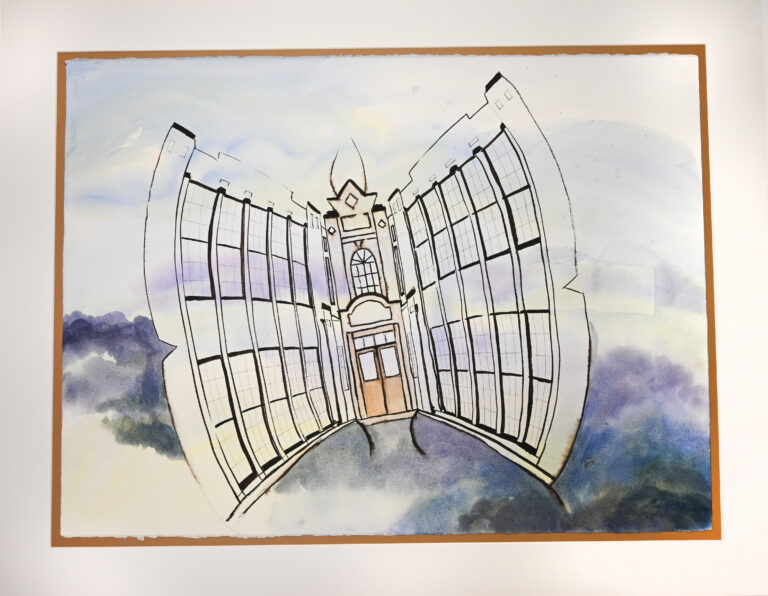
The Art Gallery of Grande Prairie is celebrating their 50th anniversary in 2025 and in recognition of that major millstone the staff have curated an exhibition to showcase it’s Permanent Collection.
The organization has had a rather wild journey during the past five decades. Their story starts in 1975 when a group of concerned citizens began the process of establishing an art gallery in Grande Prairie and the following year the Prairie Gallery Society was established under the Societies Act of the Province of Alberta. The Art Gallery has had many homes, thier first home was an old chemistry laboratory provided by the Grande Prairie Regional College. Then in 1981 they moved to a former church called Speke Hall, the building was transformed from a dull church hall to a well-lit and spacious gallery, this move was a major stepping stone. From there, the Gallery moved in 1985 to the Grande Prairie High School, a historic building built in 1929. The Gallery remained there for 22 years, when on March 19, 2007, almost half of the Gallery unexpectedly collapsed under the heavy snow load on the roof. After the full restoration was complete in 2012, the Art Gallery of Grande Prairie opened in its current and final location in the Montrose Cultural Centre.
The Art Gallery of Grande Prairie’s Permanent Collection currently stands at approximately 850 works of art, almost exclusively created in Alberta in the mid to late 20th Century. This exhibition showcases a variety of works by iconic Peace Region artists, along with a painted sculptural piece which was a desk from the historic High School building.
Curated by the staff at the Art Gallery of Grande Prairie.
Featured image: Vikki Hot, PAG Metamorphosis, 2001, Acrylic and ink on paper, Collection of the Art Gallery of Grande Prairie.
Featured Artists
John Snow
John Harold Thomas Snow was raised between Vancouver, BC, England,UK, Olds, AB, and Innisfail, AB. At age 15, he told his father he wanted either to be a banker or a painter, and had successful careers as both. In 1928, he joined the Royal Bank of Canada, first in Bowden, AB, then in Calgary, from which he retired after 43 years at age 60. His time with RBC was inter-rupted only once, with his enlistment and overseas tour during World War II from 1940-1945.
Once back in Calgary, Snow began studying life drawing under Maxwell Bates and experiment-ing with woodblock printing techniques. In 1953, Snow and Bates rescued two decommissioned lithography printing presses and several old limestone blocks from the Western Printing and Li-thography Company, and Snow quickly established himself both as a master lithographer and an instrumental mentor to colleagues and new artists. He exhibited nationally and internationally during his lifetime in print and graphics biennials, as well as in solo and group gallery shows. His landscapes, still lifes, florals, and portraits in lithography, watercolour, oil, mixed media, concrete sculpture, textiles, and intaglio relief helped usher Alberta into the modernist period.
Snow worked diligently and prolifically until 1992 and died peacefully in 2004. The awards be-stowed upon him are numerous; notable among them are the Salon des Beaux Arts, Paris (1965), an honorary Doctorate from the University of Calgary (1984), the Alberta Achievement Award (1984), and the Alberta Order of Excellence (1996). His work is held in the collections of the Medicine Hat Museum and Art Gallery, the Glenbow Museum, the Art Gallery of Alberta, the Alberta Foundation for the Arts, Alberta Government House Foundation, and the National Gal-lery of Canada. In 2001, Snow’s two-storey home in Lower Mount Royal (Calgary), where he lived and worked for nearly 50 years, was purchased by Calgary author Jackie Flanagan to ac-commodate writers who took part in the Markin-Flanagan Distinguished Writers Programme. As of 2010, the John Snow House is administered by The New Gallery. It holds their resource centre (a combined library and archive), hosts an artist-in-residence program, and is available for community events.
Illingworth Kerr
Illingworth Kerr studied at the Central Technical School, Toronto in 1924. From 1924 to 1927, Kerr studied under Arthur Lismer, J.E.H. MacDonald, Frederick Varley and J.W. Beatty at the Ontario College of Arts. Kerr also studied at the Westminster School of Art, London, in 1936, as well as with Hans Hoffman in Provincetown, Massachusetts in 1954. In 1955 and 1957, he attended Emma Lake Workshops.
Kerr traveled the Georgian Bay area, Ontario, in 1927, and England and France from 1960 to 1961. He taught at the Vancouver School of Art from 1945 to 1946, and was head of the Alberta College of Art from 1947 to 1967. He was a great influence and friend to many artists of that era. As well, from 1952 to 1953, he was president of the Alberta Society of Artists. Kerr was also a member of the Canadian Authors Association; he wrote many short stories and illustrated many publications, including his autobiography, Gay Dogs and Dark Horses, in 1946. He received a Canada Council Award in 1960.
He painted portraits, the life of Indigenous peoples, urban views, wildlife, and the Prairie and Ontario landscape. He used the media of oil, acrylic, watercolour, charcoal, and ink, as well as woodblock, linoblock, monotype and silkscreen prints.
Elizabeth Ginn
Elizabeth Ginn was born in Saint John, New Brunswick. She moved to Ontario in 1959 and then to Alberta in 1977. She studied at the Ontario College of Art, received a Bachelor of Fine Arts Degree from the University of Lethbridge, and also pursued graduate studies at the Emily Carr College of Art and Design in Vancouver. In addition to her art studies Ginn has taught art therapy to mentally handicapped clients and also served as gallery director at the Art Gallery of Grande Prairie.
Ginn is an expressionistic painter and has exhibited her own work in Alberta and British Columbia. Her work usually deals with subjects that are very close to her emotionally, such as birds, cats and flowers.
Ginn currently lives in Lethbridge, Alberta, and besides continuing her artistic pursuits manages a cat rescue society.
Euphemia McNaught
Euphemia or Betty from Beaverlodge, as she was known, was the youngest of six children and was always interested in art. In 1912 the family left Ontario and travelled west to Edson by train, then on to the Peace River country in an ox cart on the newly opened Edson Trail. They settled in a homestead near Beaverlodge where she attended Appleton School. She went on to high school at Lake Saskatoon and then studied to become a teacher at the Normal School in Calgary. Upon graduation, she returned to the Appleton School where she taught for two years. She would later buy the old school and have it moved to her farm where she used it as a studio.
After two years of teaching she decided that she would prefer to be an artist. She saved her money and on the advice of her brother John she enrolled at the Ontario College of Art where she studied under Arthur Lismer and J.E.H. MacDonald along with fellow Albertan classmate Annora Brown. She graduated in 1929 and moved to Calgary where she taught for two years at Mount Royal College. She exhibited with the Alberta Society of Artists in 1931 at the Calgary Exhibition and Stampede. She went back to Ontario in 1935 to teach art at the Ontario Ladies College in Whitby, Ontario but returned to Beaverlodge after only a year following the death of her father. She spent much of her spare time travelling around the Peace Country sketching and painting and established herself as the most prominent artist of the region. During the war, she and, her friend, Evy McBryan received permission from the Prime Minister of Canada, Mackenzie King, to document the construction of the Alaska Highway in paintings. From 1955 to 1958 she taught art classes for the University of Alberta Department of Extension in and around Grande Prairie. She frequently exhibited her works in both solo and group exhibitions as well as illustrating a local history book “Beaverlodge to the Rockies”. She was a founder of the Grande Prairie Art Club the Beaverlodge Art Club, and an active member of the Peace Watercolour Society. In 1977 she was awarded the Alberta Achievement Award of Excellence in Art and later in 1982 the Sir Frederick Haultain Prize in recognition of a lifetime of service and exceptional accomplishment. In 1985 she became a lifetime member of the Alberta Society of Artists.
Working mainly in watercolour, oils, and pen and ink, her Peace Country landscapes and pioneer scenes which often depicted horses are found in many private collections in Alberta and around the world. Her work was exhibited at the National Gallery of Canada in Ottawa before her death at the age of 100 in 2002.
Thelma Manarey
Thelma Manarey was born and raised in Edmonton, Alberta. As a young girl, Manarey received tutelage from Florence Mortimer, a well-known painter and teacher located in Edmonton. From 1939-1943, Manarey studied at the Institute of Technology and Art (today the Alberta College of Art & Design). At the Institute, Manarey had the opportunity to study with famous landscape painter, H.G. Glyde. Although Manarey is generally known for her small etchings, she explored many different types of mediums and artistic styles. Manarey tried her hand at: impressionism, realism, cubism, and abstract impressionism. In the late 40’s, she learned the art of the serigraph. Later, during the 1950’s and 1960’s, she studied etching with Harry Savage as well as stone lithography in Toronto, Ontario.
Manarey, like so many other notable Albertan artists, was a great admirer of the Alberta Landscape and the natural and man-made icons of the province. These objects, such as trees and elevators, often became the subject matter of her etchings and paintings. In 1973, Manarey received the Performing and Creative Arts Award, from the City of Edmonton. Additionally, The Alberta Society of Artists honoured Manarey with the gift of a Lifetime Membership. Today, Manarey’s works reside primarily at the Alberta Foundation of the Arts, the Nickle Arts Museum in Calgary, and the University of Calgary.
Daniel Bagan
Wesley Daniel Bagan credits the strength of his work to his practice of working on-site outdoors, and observing a scene carefully in order to address the challenges of composition, texture, light and shade. He is a visual artist whose work is held in public and private collections around Alberta.
Bagan’s paintings and drawings include series of works of northern Alberta’s Peace River valley and region and the Lac St. Anne area, where he focuses on capturing the beauty of the natural world and creating a record of the disappearing landscape. Many of his works include sunsets or sunrises, and he has also returned regularly to a series of drawings he has been adding to over a twenty-year period that depict the urban nocturne. In this series, he draws the empty alleyways and backyards of the city, and often incorporates elements of the poetical or theatrical. He exhibits actively at galleries and festivals in Alberta as well as at community venues such as libraries, restaurants and cafes.
Bagan was born in Terrace, British Columbia and moved to Alberta as a child. In 1978, he received a BFA from the University of Alberta.
Evy McBryan
Evelyn Beatrice Hook was born in Somerset, England on April 25, 1911. She was the second child of Clifford Stanley Hook and Jessica Beatrice Williams. The Hook family emigrated to Canada in 1913. They stayed awhile with Jessica’s brother in Regina before moving to Edmonton, where Clifford, a jeweller and watchmaker, was employed by G. F. Watcher. The Hook family moved to Grande Prairie when Clifford purchased the R. H. Watcher business in March 1918. Except for a brief time in Ontario ca. 1919-1920, when her father attended the College of Optometry, Evy spent the remainder of her life in Grande Prairie.
Evelyn McBryan was a tireless worker for Visual Arts in the Peace Country. She organized the Grande Prairie Art Club out of her own home, and became the director of the Arts and and Crafts Guild in 1958. She also served as the Coordinator for Arts and Crafts for the City of Grande Prairie (1964-1974), on the provincial Board of Culture and the Visual Arts Board (ca. 1960), and on the Alberta Arts Foundation Board (ca. 1973), where she established a school exhibition program and organized the Peace Region Arts Council. She also assisted in establishing the Prairie Art Gallery. For all of these efforts, in 1976 she was awarded the Alberta Achievement Award.
After re-tiring from all her boards and committee work, Evy continued with her own artwork. Her last one-woman show was at the Prairie Art Gallery in October 1982; and her last exhibit was held in Beaverlodge, where she had studied with Euphemia McNaught, in the spring of 1983. Evelyn McBryan died in Grande Prairie at age 74 on October 19, 1985.
Dorothy Henzell Willis
Visual artist Dorothy Henzell Willis was born in Northumberland, England in 1899, and moved to Edmonton, Alberta in 1912. Dorothy studied drawing and painting at a variety of institutions, including the University of Alberta and Columbia University.
Her style is expressionistic and Dorothy’s drawings and paintings were representations of what she saw and experienced in her daily life. Her pieces are honest and always colourful, and include a variety of subjects from man-made structures, to nature, to people. Dorothy was a member of the Edmonton Art Club, the Alberta Society of Artists, the Edmonton Sketch Club and the Alberta Women Sketch Hunters.
Dorothy’s work has been shown in Edmonton, Vancouver, Winnipeg, Montreal and Toronto. Some of her works are held by the Alberta Foundation for the Arts and by a number of private collectors.
Dorothy passed away in 1988.
Garry Newton
Newton was born July 2, 1939 in the City of York. In 1948, at the age of 9, he immigrated to Medicine Hat, Alberta with his family. He studied science at the University of Alberta in Edmonton, Alberta and completed his science degree in Zoology at the University of Melbourne in Australia. After receiving his degree, Newton travelled, visiting a vast majority of North America, Europe, Central America, and Greece. After returning from his worldly travels, Newton settled in Calgary, Alberta and started to focus primarily on creating intaglio prints. In 1958, he received a Canada Council Grant to produce approximately 50 prints of the Amaryllidaceae plant family. Newton was also picked to display his work at the 6th International Invitational Exhibition of Botanical Art and Illustration. Later in his life, he taught drawing classes in Medicine Hat, Alberta. Newton also contributed significantly to the book, Prairie River, in which he created the illustrations and maps. Newton, met his partner, Elwood Amundson in 1993. Together, they mastered the technique of marquetry. Newton’s work resides in collections at the Medicine Hat College, the Calgary Library, the University of Alberta, the Medicine Hat Gallery, and the Carnegie-Mellon University at the National Library of Canada. Newton passed away on May 15, 2008 in Medicine Hat.
Vikki Hotte
Vicki Hotte is an established visual artist from the Peace River Region of Northern Alberta. Her interest, from childhood, in art-making became real when she completed a Visual Arts Diploma at Grande Prairie Regional College and went on to finish a Fine Arts Degree with honours at the University of Victoria. Since then, she’s been creating art in her studio at the Beaverlodge Art and Culture Centre.
Her work has been shown regularly throughout the Peace River Region and beyond. She has work in the permanent collections of the Alberta Foundation for the Arts, the Art Gallery of Grande Prairie, the Dawson Creek Gallery, and was awarded Honourable Mention at the 2009 Lieutenant Governor’s Gala. “Inspiration comes from nature and rural life, always flowing, shifting, and re-surfacing, and woven with threads of faith and humour.”
Jim Stokes
In making and exhibiting my work since 1979, I have explored many approaches to making art. I continue to draw the figure with energy and enthusiasm. I have explored printmaking and for the last 6 years have done a great many experimental sculptures. The main constant of my work, has been the Alberta landscape. Almost all my exhibitions have presented paintings trying to extend this tradition of painting and interpreting the world around us. The wild places, the neat “tucked in” sections of agricultural land and the rolling folds of the prairie parkland. With this has been an obsession with the arch of sky and cloud above. Clouds the weather offer an endless subject with forms motifs that are simple, minimal and abstract to the wild and rococo! I find a lot of joy and pleasure in painting.
James Agrell-Smith
Born in Stettler, Alberta in 1913, James Agrell Smith began sketching by drawing samples of plants and other materials that he picked up on nature walks on the prairie north of town with his father, who had a keen interest in the natural world. His inclination to make art was stimulated by these experiences and, other than taking a brief summer art course at Mount Allison University in Sackville, New Brunswick in 1944, it was an occupation that he studied on his own. He enlisted in the Royal Canadian Navy as a boy seaman in 1931 (he was seventeen), and upon his discharge in 1947 worked as a freelance artist. In 1950, he took a full-time job with Canada Post in Red Deer, Alberta, where he worked until his retirement in 1970.
Although James Agrell Smith worked in a variety of media, his highest accomplishment was in the graphic media, working with sumi-ink drawing, wood engraving, woodcuts and woodblock prints. His prints and drawings were generally small-scale, detailed and full of expression, and his preferred subjects included portraiture, including self-portraits, figures, and rural scenes. Agrell Smith had a very important influence on the development of printmaking in Alberta. He became an associate member of the Canadian Society of Painters, Etchers, and Engravers (CPE) in 1952, assuming full membership in 1954. Smith was instrumental in setting up the Western Chapter, Edmonton Branch of the CPE and exhibited regularly with that organization during the 1950’s and 60’s. He participated in the influential Hart House show entitled Western Printmakers Exhibit in 1957, as well as at the Northwest Printmakers International Exhibitions in Seattle, Washington, USA in the 1960’s. Agrell Smith’s prints can be found in the public collections of the Alberta Foundation for the Arts, the Art Gallery of Alberta, and the Glenbow Museum as well as many private collections.
Activities
Funded by


Share This!