This is Home
This is Home
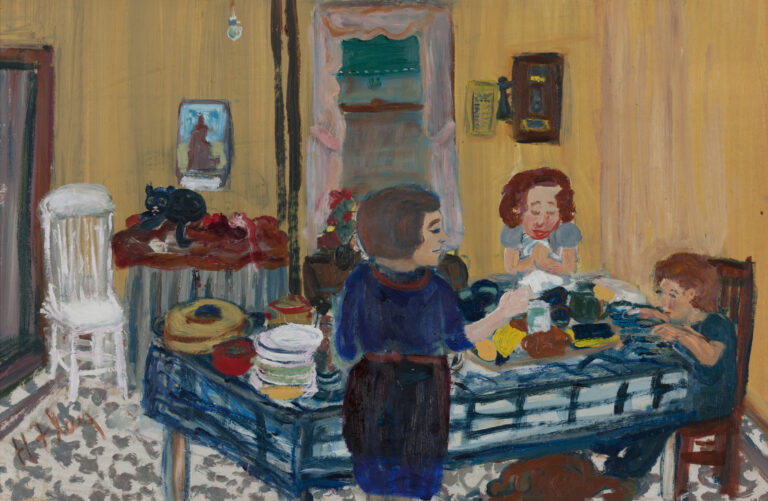
We make many different connections to objects, people and places as we grow up and these experiences mold us into the person we become. When visualizing the feeling of ‘home’ someone may produce in their mind an image of the area they were born, a house they were raised in, or a memory of their childhood. Featuring artworks from the Alberta Foundation for the Arts Permanent Collection, This is Home presents a variety of visual narrations of what the artist experienced in their home life.
As you view the collection of works, embrace the feelings and connections that come to you. How do you feel when you stand in front of Garry Newton’s Ideal Room: Manic, or Edward Bader’s McCarroll’s Living Room? As you engage with the images you might be taken back to a memory from growing up or even from this year. Looking at Rohnda Galper or Caroline Adrian-Clark’s work, they have depicted siblings bonding over chatter, which would be a common memory of home life for many.
This is Home portrays meaningful scenarios that each artist experienced in life. For some home extends beyond a physical structure and encompasses feelings of safety, comfort, belonging and love. It’s a place where individuals feel they belong, are protected, accepted, and could easily generate an image in their mind when asked, what is home to you?
Curated by Jamie-Lee Cormier, Curator/Manager of Travelling Exhibitions Northwest
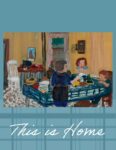
Featured Image : Helen Flaig, Dishes, 1996, Oil on masonite, Collection of the Alberta Foundation for the Arts
Featured Artists
Percy Henson
Born in Three Bridges, Sussex, England in 1890, Percy Henson came to Canada in 1913, settling in Calgary where he operated a barber shop and became active with the Young Men’s Christian Association. He moved to St. Catherines, Ontario and then to Windsor, Ontario as general secretary of the YMCA there. In 1939, he moved to Sidney, Nova Scotia to open a YMCA and then to Lethbridge, Alberta where he retired from the YMCA as general secretary.
Percy Henson came to art late in life. He began painting at the age of fifty while he lived in Sidney, where he was involved in the Sydney Art Club, and later received art education at summer schools at the Ontario College of Art (studying under J.W. Beatty) and at the Banff School of Fine Arts. A Director of the Edmonton Art Gallery from 1951 to 1964, he was a member of many arts associations, including the Edmonton Art Club, the Alberta Society of Artists and the Society of Canadian Painter-Etchers and Engravers. Upon his retirement from the Edmonton Art Gallery, he became an instructor in landscape painting with the Department of Extension, University of Alberta.
A representational painter of landscapes and city scenes, Henson’s work was very much influenced by modern abstract design. His paintings and sketches of landmarks in Edmonton and vicinity were highly regarded, and earned him the Performing and Creative Arts Award of Distinction from the Alberta Historical Society.
Frederick McDonald
Frederick R. McDonald’s early years were spent living along the Athabasca River following the traditional way of life of his Woodland Cree heritage. Hunting and trapping was an important part of his life until he finished high school. He then worked in the oil industry and after many years left his home to travel and to pursue a Bachelor of Fine Arts degree at the University of Calgary. In 2015, Frederick was appointed as Director to the Board of the Alberta Foundation for the Arts.
Frederick’s work is concerned about the written and visual history of his people in Canada; and he strongly believes it is time the Aboriginal people tell their own story.
Frederick’s culture recognizes honours and respects Creation and its wonders of colour. His work is a mixture of styles and expressions; this allows him greater opportunities to have a discourse within many segments of our Canadian mosaic. He uses colours and symbols to capture the experiences, the characteristics and the spirituality of his people and he paints in a style he refers to as “The Colour of My People”.
Helen Flaig
Helen Flaig was a self-described naïve painter who used acrylics and oils to paint everyday scenes of her life growing up on a farm in Saskatchewan. Her paintings are spontaneous and whimsical, full of colour and warmth, and reflect the games, play, and the work she shared with her siblings on their farm in the 1930’s. Flaig painted detailed scenes of everyday life; milking cows, shelling peas, and the careful production of washing dishes. She also captured her happy existence during that time, including kite-making, water fights, and riding to school in a horse-drawn cutter.
Flaig trained as a teacher, and moved to Lethbridge with her husband and children in 1955. It was in Lethbridge that Flaig’s passion for art flourished. She joined the Lethbridge Sketch Club and learned the art of watercolour. She continually developed her skills with art courses and workshops from the Lethbridge Community College and the University of Lethbridge; summer courses from Red Deer College; and figure drawing sessions at the Bowman Arts Centre.
Flaig was also a potter and a member of the Oldman River Potter’s Guild, and experimented with clay sculptures and primitive firings. Flaig was active in her arts community and frequently exhibited her art and pottery throughout Lethbridge and Medicine Hat.
James Nicoll
James (Jim) Nicoll was born in Fort Macleod, Alberta in 1892, and he primarily grew up in Nelson and Fernie, British Columbia. He served in WWI, and after the war studied civil engineering at the University of Alberta. Jim started painting in 1930, while he was working as an engineer for the Canadian Pacific Railway (CPR). Nicoll met his wife, well known Calgary artist Marion Mackay [Nicoll], at the Calgary Sketch Club in 1931. They married in 1940. In the years that followed, the two travelled around Western Canada because of Jim’s engineering job with the Royal Canadian Air Force. In 1945, they settled in Bowness, a village just west of Calgary, Alberta. Jim was a realist painter, who worked primarily with oils. He was a self-taught artist who believed in representing the correct anatomy of objects, architecture, and people. He also disliked the pretentiousness that can sometimes be equated with the creation of art. In 1958, Jim and his wife travelled to New York to study with Will Barnet at the Art Students’ League in New York City. Like his wife, Nicoll was important to the creation of the art scene in Alberta and Calgary. He was the editor of Highlights, the bulletin created by the Alberta Society of Artists, and he eventually became the chairman of the Visual Arts Committee in Calgary. Nicoll primarily exhibited his work in the 1960’s and 1970’s. He also expanded his artistic tendencies into writing and poetry, and in 1980 his book entitled, The Poetry and Prose of Jim Nicoll was released. Nicoll passed away in 1986, approximately a year after his wife.
Pat Nokomis
Born Ojibwa in the bush two hundred miles north of Lake Superior, ON, Nokomis (nicknamed “Pat”), paints memories of a traditional culture where many people were still living by hunting, fishing and trapping. Each painting is a narrative, a brief moment in time that captures real people going about their lives. Nokomis says she has always been a storyteller but she hasn’t always been an artist. In her sixties she began to use art to illustrate her stories. Although she has no formal art training, Nokomis began her artistic career by first learning the traditional crafts – smoking hides to make moccasins, jackets, mukluks and small beaded jewelry items. In 1993-1994, she did pursue professional development in her art in Calgary, AB.
Her acrylic paintings are a naïve, colourful and charming remembrance of her life as a child. About ten years ago, Nokomis began teaching herself to make mille fiore glass canes from man-made polymer clays in the manner of the Venetian bead makers. She used the canes to make art objects and jewellery. These objects are contemporary beaded necklaces, quaint little “lady pins” or keychains that sometimes follow native themes. Nokomis uses her art and storytelling to teach Ojibwa traditions and spirituality. Her stories and art are reproduced extensively in books, prints and cards.
Ken Swan
Edmonton-born artist Ken Swan began drawing at the age of four, and his artistic career blossomed, thanks to the early encouragement of teachers who recognized his talent and potential. His works were initially mostly pen and ink sketches, but he also branched into creating wood sculptures and watercolour paintings. His work often featured characters he observed or envisioned.
He lived for 13 years at Enoch Cree Nation, west of Edmonton, then moved to St Paul, Alberta. There he freelanced as a graphic artist and cartoonist for the St Paul Journal. He studied life drawing at Vermillion College, and later enrolled as a student in the drawing program at the then-Alberta College of Art, Calgary.
In 1988, he won First Prize at the Native Art Collection Award, a juried competition sponsored by Peace Hills Trust, Edmonton. He also participated for several years in the Asum Mena (the Cree expression for “once again”) Native Arts Festival held annually in the late 1980s and early 90s at the Front Gallery, Edmonton. Ken Swan was named as first or second runner-up several times. In particular, he received praise for “The Casket” (1987), a detailed pen and ink drawing with colour wash, showing mourners at a funeral that suggests the link between mortality and immortality, and generational lineage.
In 1990, he was part of a group show, Catch the Rising Spirit, sponsored by NOVA Corporation and held in Edmonton and Calgary. Again, his pen and ink drawings of Indigenous life received accolades. In 2014, his work was displayed in a group show at Enterprise Square Galleries, part of kiyas aspin (Cree for “it’s been a long time since….”), in conjunction with the seventh and final national event for the Truth and Reconciliation commission, held in Edmonton. This exhibition was presented by Aboriginal Affairs and Northern Development Canada and featured works from the Alberta Art Collection (formerly known as the Alberta Indian Arts and Crafts Association Collection).
Dorothy Henzell Willis
Visual artist Dorothy Henzell Willis was born in Northumberland, England in 1899, and moved to Edmonton, Alberta in 1912. Dorothy studied drawing and painting at a variety of institutions, including the University of Alberta and Columbia University.
Her style is expressionistic and Dorothy’s drawings and paintings were representations of what she saw and experienced in her daily life. Her pieces are honest and always colourful, and include a variety of subjects from man-made structures, to nature, to people. Dorothy was a member of the Edmonton Art Club, the Alberta Society of Artists, the Edmonton Sketch Club and the Alberta Women Sketch Hunters.
Dorothy’s work has been shown in Edmonton, Vancouver, Winnipeg, Montreal and Toronto. Some of her works are held by the Alberta Foundation for the Arts and by a number of private collectors.
Dorothy passed away in 1988.
Garry Newton
Newton was born July 2, 1939 in the City of York. In 1948, at the age of 9, he immigrated to Medicine Hat, Alberta with his family. He studied science at the University of Alberta in Edmonton, Alberta and completed his science degree in Zoology at the University of Melbourne in Australia. After receiving his degree, Newton travelled, visiting a vast majority of North America, Europe, Central America, and Greece. After returning from his worldly travels, Newton settled in Calgary, Alberta and started to focus primarily on creating intaglio prints. In 1958, he received a Canada Council Grant to produce approximately 50 prints of the Amaryllidaceae plant family. Newton was also picked to display his work at the 6th International Invitational Exhibition of Botanical Art and Illustration. Later in his life, he taught drawing classes in Medicine Hat, Alberta. Newton also contributed significantly to the book, Prairie River, in which he created the illustrations and maps. Newton, met his partner, Elwood Amundson in 1993. Together, they mastered the technique of marquetry. Newton’s work resides in collections at the Medicine Hat College, the Calgary Library, the University of Alberta, the Medicine Hat Gallery, and the Carnegie-Mellon University at the National Library of Canada. Newton passed away on May 15, 2008 in Medicine Hat.
Activities
Funded by



Share This!